
The Day I Stopped Flying Piston and Started Flying Fast
Transitioning from a prop to the Citation Mustang wasn't just a type rating — it was a hard reset on everything I thought I knew about flying.
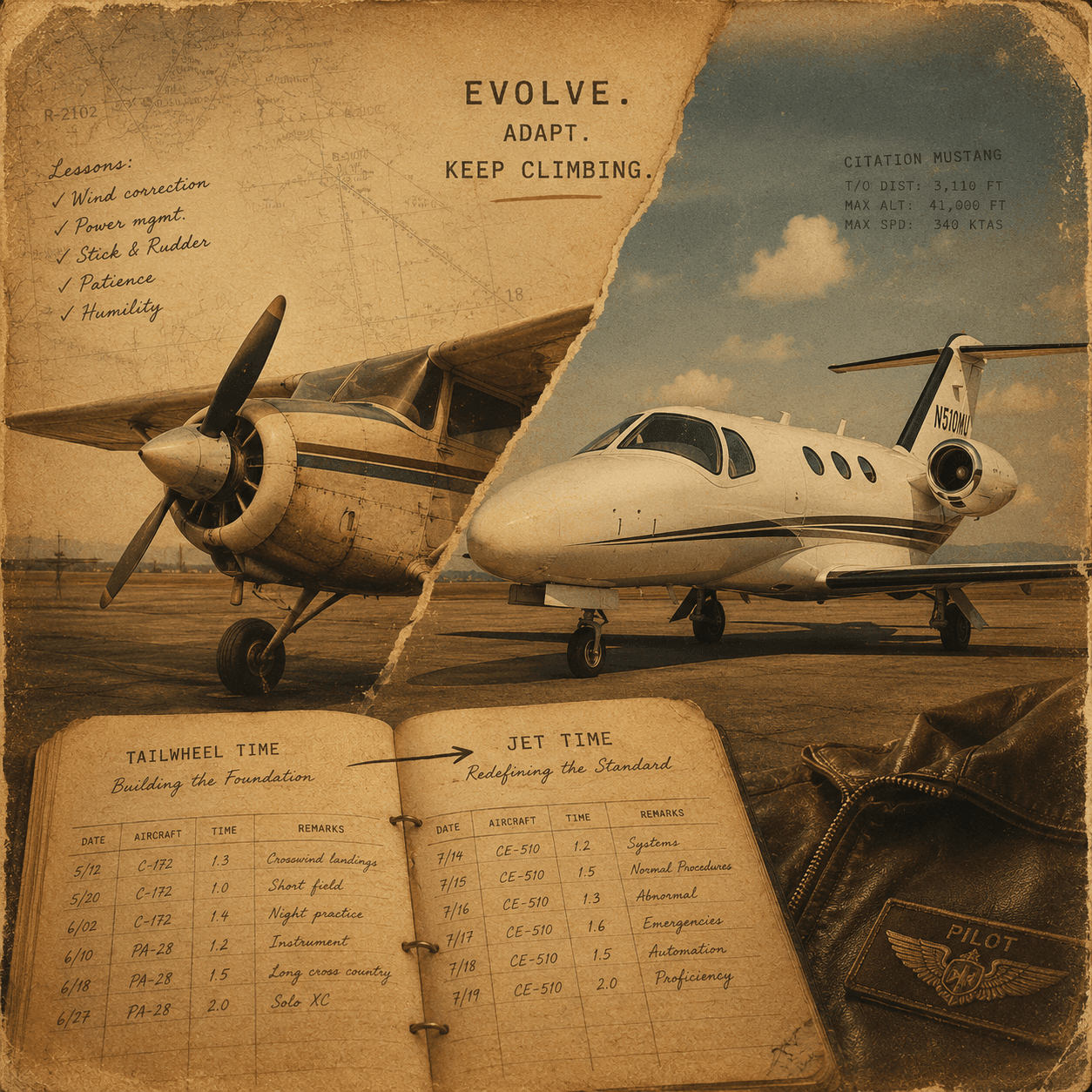
The turbine bit caught me by surprise — not because it was complicated, but because it was ruthlessly honest. The Mustang doesn't care how many hours you logged in a Bonanza or how smooth your ILS approaches were in a Cherokee Six. It asks better questions.
I came up through pistons the traditional way. Instrument ticket in a Cessna 172, built time in a Piper Arrow, eventually flew a twin for a few years before someone handed me a chance at a jet transition. I thought I was ready. I was mostly wrong.
The Sim Will Humble You First
FlightSafety in Wichita runs the initial type rating program for the CE-525. You show up thinking your instrument scan is solid. The sim reminds you that speed management in a jet is a completely different animal. In a piston twin, you have time to think. In the Mustang, especially on a high-workload arrival into a busy terminal, the airplane is always slightly ahead of you until you learn to think further out.
V1 cuts, engine-out ILS approaches, high-altitude upsets — the sim curriculum earns its reputation. I walked out of several sessions genuinely tired in a way that cross-country piston flying never produced.
What No One Tells You About the Actual Airplane
The Mustang is small. That surprises people. It fits in a single-engine tiedown and burns around 60 gallons per hour at cruise — modest by jet standards. But it climbs to FL410, and that changes the mission entirely.
Your first takeoff in the actual aircraft is a moment you remember. The Williams FJ44 engines spool up and the acceleration is immediate and committed. The rotation is faster than your hands expect. You're through 10,000 feet before you've finished cleaning up the airplane.
What caught me most was the energy management piece. In a piston, you bleed speed by pulling power and waiting. In the Mustang, you plan descents fifteen, twenty minutes out. You think in flight levels, not altitudes. You file IFR every single flight — there's no casual VFR hop to the beach in this airplane.
The Mental Shift Is the Real Transition
People focus on the stick-and-rudder differences. Those matter, but they're learnable in weeks. The deeper change is how you think.
Single-pilot IFR in a jet means you're managing the avionics, the ATC workload, the weather, the fuel burn, and the descent profile simultaneously. The Garmin G1000 NXi in the Mustang is capable and well-integrated, but it rewards pilots who brief aggressively and stay ahead of the automation.
I flew with a mentor pilot for my first dozen hours after the type rating. Best decision I made. Book knowledge and sim time give you the certificate. Real mentorship gives you judgment.
The Mustang turned out to be exactly the right airplane for my operation — economical for a light jet, capable enough to handle the Florida summer weather that makes this region genuinely demanding airspace. But it asked me to become a different kind of pilot first. That part took longer than the checkride.